Showing posts with label water. Show all posts

Thursday, August 6, 2015

Cleaning Orbaizeta old munition factory in community work

The Orbaizeta arms factory was one of the largest weapons factories in Europe in the late eighteenth century. Although he is known by this name, actually they manufactured munitions (bombs, grenades and solid balls for guns).
It was  running  difficulty during 100 years, and soffer many wars, destruction and fires, which affected the villages of the valley of Aezkoa and therefore their neighbors for generations.
Today, once returned  the property of  the mountains in 1982 expropriated by the Spanish crown, and recovered its ruins by the  Aezkoa Valley council, is BIC (belongins of cultural interest). They most of the ruins can be visited but  they require consolidation and maintenance

Cleaning the yard  of carpentry and locksmithing


The money than before the crisis had to consolidate the ruins (PDR sustainable) disappeared, and the situation of the ruins is precarious. There are areas where you should not go because there is a risk of falling stones, and they are areas fenced that people are not always respected, but many others are visited.
  For this wide area, last year some neighbors of  the tourism sector of the valley started to coordinate and propose to make an auzolan to the Aezkoa Valley council.
The auzolan or artelan ( means neighborhood work) is a figure of community organization typically Basque, where neighbors get together to do a job for the benefit of the community, as in this case

Other times someone could summon his neighbors, to do some private work, like fixing a roof, but that person would always be willing to back the aid.
In the twentieth century this practice began to disappear, The village councils began to pay to third parties some of the work previously done in auzolan, and people will not need their neighbors and prefer to pay professionals arrangements.
Need was what kept the community together, and now also many people only go to the villages for the weekend.


The famous 22 arches separating the coal cellar and the  furnaces

If no money but there is goodwill, there is much that can be done.
This year we also have met for that purpose. The grass that usually invade the factory had been cut almost entirely by two council workers in May, but it waas necesary another cut, finish cutting the parts waht they didn´t cut, and expose in certain places removing 1cm  of ground the old pave that  the factory had, so that in later years the plants do not grow in that area, and  people can enjoy more the visit.

We have also conditioned the descent to the river so that people can get the most typical photo, the arcades. Last year we did most of this work, and now only have had to make a few tweaks.


clean pavement
If you wonder where I was, I will say that clearing and occasionally, taking pictures so that you can see it now.
All morning it has not left us the "txirimiri," the typical fine rain in these last days of 35º C seemed a distant memory, and so in this photo  we are not exactly ready to go to a wedding,


in front of the  bokarte

It is also true that we laughed, enjoyed the difference between before and after, and ... the hamaiketako or lunch!

Txistorra (sausage) and xingarra (bacon)


The underground passages


Knowns by few people and walk almost nobody, is a network of small canals that carried water under the arms factory, being the largest of them  Iturroil stream channel, passing beneath the palace, and crosses all the factory towards the river.


Main channel

Minor channel

 Legartza stream outway

Current up

The main channel is high enough for a person to be standing comfortably, and  as much the soil as the walls are made of ashlar stones. It's probably the best preserved of the whole factory, but  visit is not easy.

If one day you want to see any of these areas and see some of the tiles of the old iron roof,cannonballs, knows how life was  in this place, you know where to find me.


Monday, March 16, 2015

Birds, flowers and wildcats in march.

After being snowing heavily during all February and have an historic snowfall, the rain came. The snow began to melt causing floods that were affecting localities of the midle and south of Navarre..
In this bend the Irati River flooded the road and was cut overnight.


Irati  riveer between Orbara and Aribe ( Aezkoa valley)
when the snow melted, the grass was been visible, and  herbivores went quickly to eat grass that was hidden.
When snow began melting
Deer grazing. Picture taken from the window of my house.

But the field mice ( Apodemus sylvaticus) and moles (Talpa europea) also took advantage of these days of tranquility to leave their burrows. The Wildcats (Felis silvestris) stand guard at the entrance of molehills or mouse burrows, waiting to attack minimal movement.
Sometimes, in the same meadow, I saw a fox, 4 deer and one wildcat.
On another occasion, I saw up to three Wildcats in the same field, and a fourth in the other side of  the Irati river.

Wildcat  (Felis silvestris)
Often  they are near from the villages, so, how can we recognize if there is a Wildcat  or common cat, at first glance, and from far away ?

  • Color: all  of them have earth color, to blend with the environment. Sometimes  they hybridize with domestic cats, and can be really difficult, if not impossible, know if they are  hybrids or not, from far away. If unfortunately we find one dead, there are typical design of dark stripes patterns on its back.
  • Tail: Much thicker than a domestic cat, has several broad dark rings, and the end with a black mark.
  • Size: There are more corpulent.
  • Behavior:  Always they are exceptions, but if it is a domestic cat let us come closer. If the wildcat is observed, and is relatively far, will tends to flee, and if we are too close, about 25 meters, often he sticks against  ground watching us, and if we have not seen him moving before, we can think it is a mound of a molehill, or cow dung.
This saw me

With snow are more visible.

Crouched, fixing his gaze in Me


But also March also brought a spectacular migration.
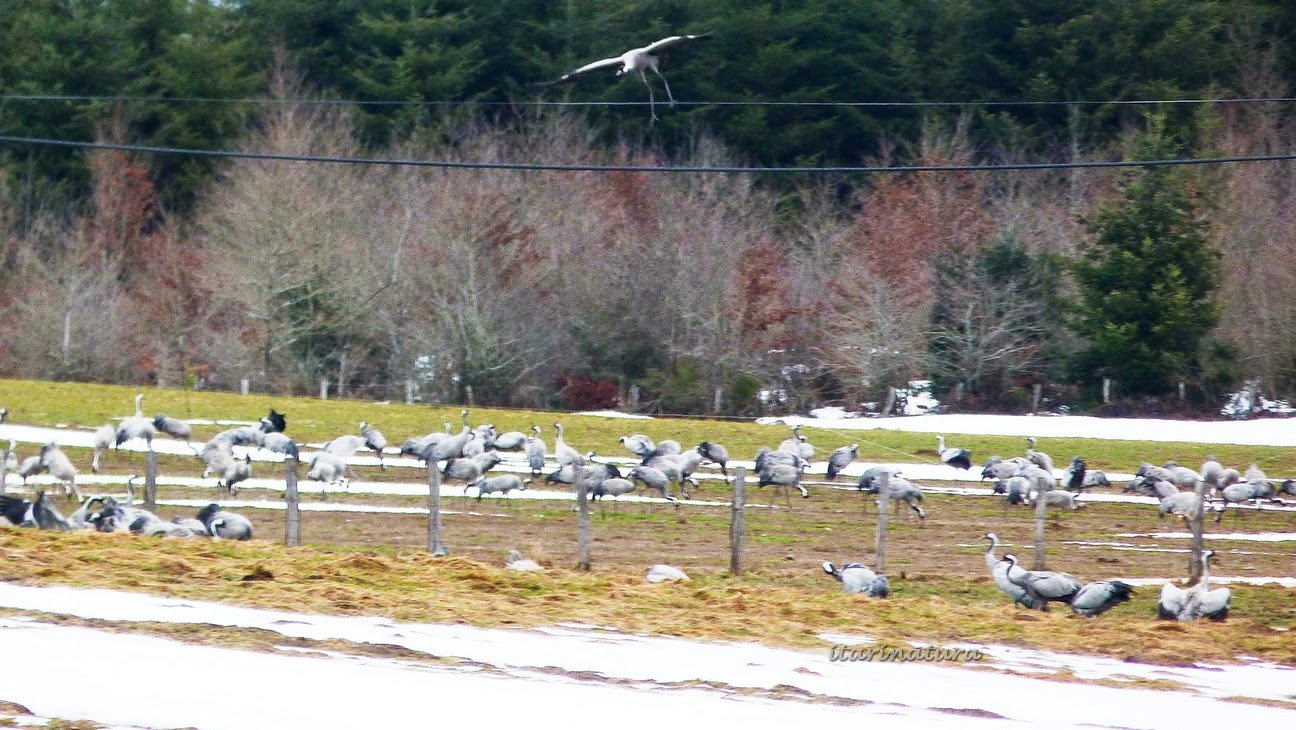
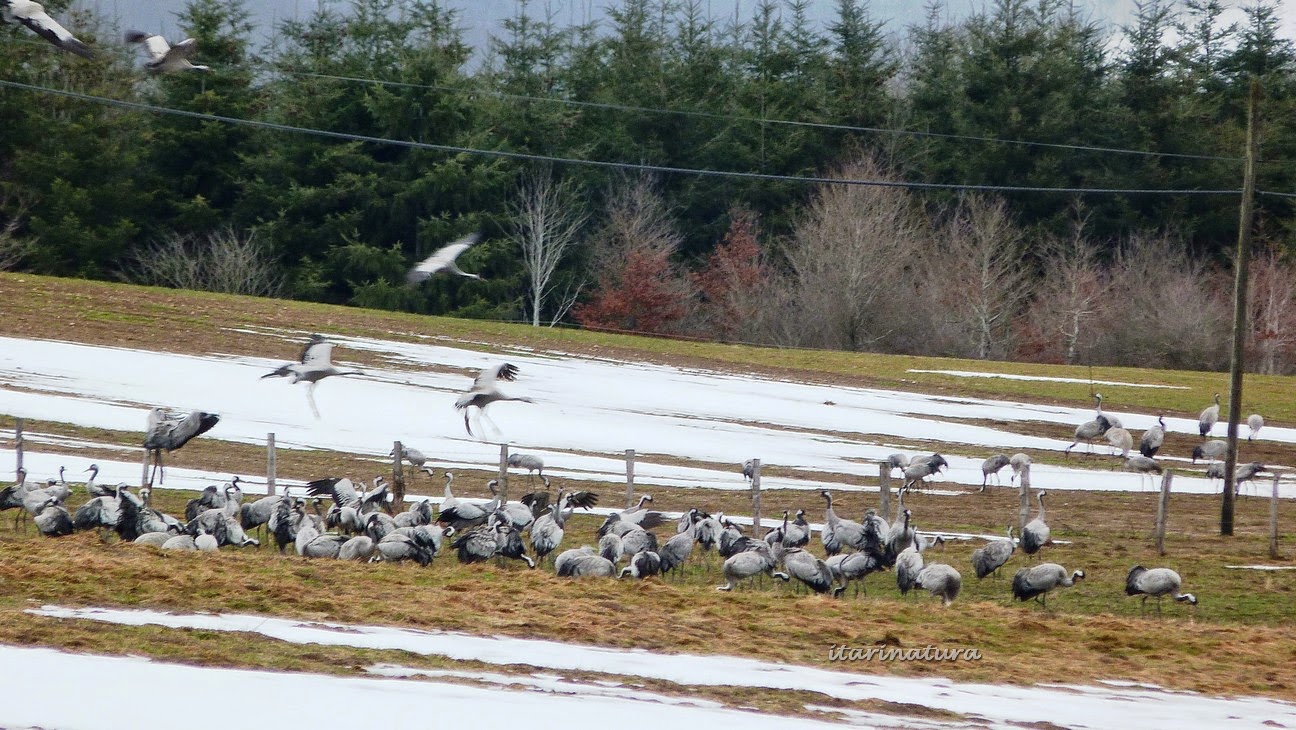
At first  the cranes came in a very good day, but the weather worsened again. Then,the white storks came, and some black storks too.

white storks in Ekai, near from Agoitz/Aoiz (Navarre)

White storks (Ciconia ciconia) on the way to the rest of Europa.
Somewhat later, on March 5, they also appeared in Orbaizeta, dozens of them.
 Older people commented place only once saw something in this village.


It happened that there were some badweather days, after having been rising temperatures and the birds that were already on the way, they met the Pyrenees covered with clouds, and decided to wait.
In the  Santiago´s way, at the crossroads of Auritz / Burguete the road to Garralda, We could see thousands and thousands of cranes circling above the meadows as deciding what they would do.

Ortzanzurieta mountain,in the end, and Auritz in the end left


Eurasian stone- curlew (Burhinus oedicnemus)

Black stork( Ciconia nigra)
Days later appeared lapwings, little Egrets and some flocks of small birds that I could not identify.
little Egret (Egretta garcetta ) and lapwings in the bottom

Lapwing (Vanellus vanellus)


The flowers that you can see below, are usually the first year to bloom by mid-January, but this year have been delayed until the first week of March!
As I have said on other occasions, The snowdrop (Galanthus nivalis) is a rare survivor of the flora that we had here in the last Ice Age. When the ice move away to the north, most of the plants and animals typical of this climate were disappearing, but some of them resist, always close to the border of extinction.

Snowdrop (Galanthus nivalis)


Finally, a photo of the full moon of March. The winter sky is spectacular to see some constellations of this time as Leo or Orion, and have a clean atmosphere. Of course, dressed with warm clothings.


Fullmoon in Nagore (  5 mars 2015)


Monday, January 26, 2015

A winter day, somewhere in Navarra


This time I will not say where I've been, because I am going to show you 2 species in danger of extinction, but I think that will be many people with the tracks that I going to give you, who will recognize the place.
If someone  want to visit it, I'll be happy to do so.

Nummulites
Lets begin with the composition of the rocks of the place; as you will see, they are full of fossils of some 55 million years ago and  marine origin. They are called Nummulites, and is a composite Latin word (nummus / coins, litos / stone). If one sees flat, they look like coins with concentric circles, but if it turns out that the bug (not an animal but a unicellular be called protist) was on side when fossilized, or broke, then they are more elliptical.
They are foraminifera,   http://en.wikipedia.org/wiki/Foraminifera a kind of macroplacton, swimming in the waters of the prehistoric sea that disappeared when the Iberian peninsula was built against the European continent.
Among its concentric circles, sprouted a number of something similar to a little hairs with which they fed.
The main of the limestone of  the  Pamplona/Iruña basin, looking to the south, are made with skeletons of trillions of these beings (Alaitz and Sarbil ranges, pilatos balcony, above Urederra fountainhead, ..)
I have found this very good link about these things:(in spanish)

http://www.geoparquepirineos.com/contenidos.php?niv=&cla=_2OA1CD0KM&cla2=_2OB01HU8N&cla3=_3MD0KXM4T&tip=3&idi=1

The second clue corresponds to the river that flow in this area. Its waters have been carving in the rock several circular holes called potholes. Sometimes,  a stone  is trapped by the current in an imperfection of the rock, as a small hole, and with the water movement this stone begin Smoothing and getting bigger the hole until it can reach several meters in diameter.

http://es.wikipedia.org/wiki/Marmita_de_gigante

Pothole with the dead trout
In this small pothole beside the river which coming rise due to the snowfall of yesterday, a poor troutfound the death. I do not know if the rise would have pushed into the pothole which later it could not get away, or died of old age after a full life, but the truth is that was recently died there. Gills were still red, but the skin was beginning to fade.
I put my hand to hand as size reference.


A few meters we can see a small seam between two limestones  of crystallized calcite. When these rocks were forming, hot water and great pressure fill of lime circulated through a crack, until calcite began to accumulate on the walls of the crack, filling them and sealing like cholesterol in our arteries. This procedure is the same when we found a vein of copper, silver, gold and many other minerals, but in that case, would be other kinds of rocks which would have to look not in sedimentary rocks, but in metamorphic, and almost always attached to quartz.


Calcite crystals 


Latest clues!
It is the Bearded Vulture foraging territory, abundant colonies of griffon vulture, and now in winter, a rare bird jewel, the walcreeper (Tychodroma muralis)!


Bearded vulture (Gypaetus barbatus)
Griffon vultures (Gyps fulvus)

Wallcreeper (Tychodroma muralis)

This beautiful Wallcreeper was takin benefit of the sun's rays to eat the few bugs that appear in the heat rock or  refuge in the numerous cracks and holes.

So, although it seems that few things to see in winter, actually in all seasons there are many things to see


Tuesday, November 12, 2013

finally..the autum ( 12 november 2013)

Beeches,Larches and red firs
Finally, the fall has been postponed more than in previous years, and still will remain about two weeks before most of the trees lose their leaves, but with the forecastof of low temperatures, leaf drop can accelerate.

Little stream, now with water

As for several days is raining, all aquifers are overflowing, and water  springs up everywhere.

 Suspension Bridge over the River Irati In Aribe(Aezkoa Valley)
We can appreciate the flow that carries the Irati river waters on their way down the ancient spa, where can see a dam that was built for the barranqueo, or transporting timber across the river, a practice which the Indians, (people from the valley who emigrated to America and back) brought to displace the rafts, that it was the most ancient of wood out of the forest.

 Irati  river after Aribe village(Aezkoa valley)

Small moth that will no longer fly.


Moss with sporophytes, where will leave the spores.

Much moisture comes in handy to mosses, lichens and fungi, although fungies are a little bit it soggy and rotten,as also the worms that eat them thrive in these conditions.

Pubescent oak (Quercus humilis) of several hundred years in the old path to the Spa


Irati River bank near one of Hemingway's fishing sites


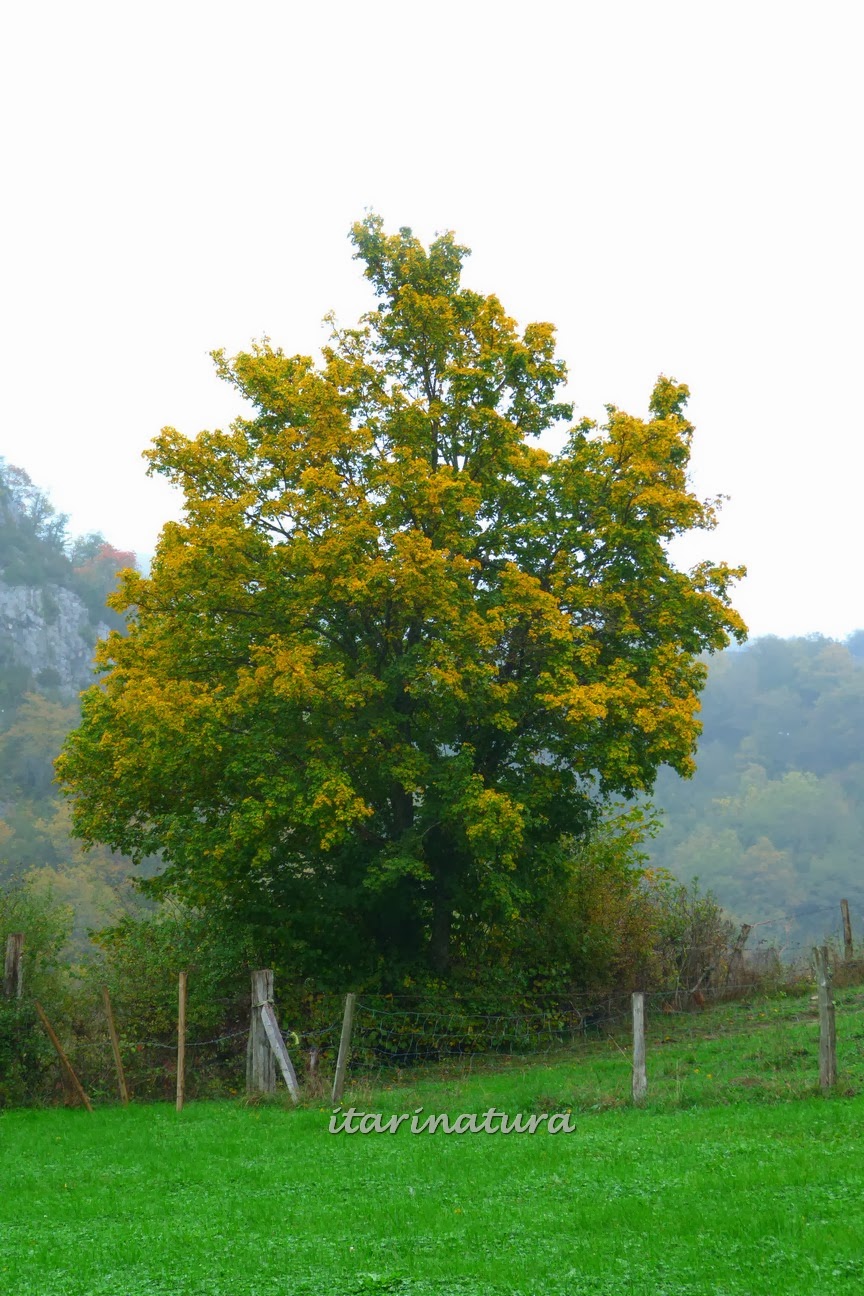
Lower Maple (Acer campestre)
araneus sp.

If you love photography of autumn, these are good days for this, and although light rain that is falling these days difficult the work, it also gives a special touch that a sunny day can not give.