Saturday, February 8, 2014

Irati horses (which are mares)

Tourists always refer to them as beautiful and wild horses, when in fact the vast majority of them are mares. The mares can have foals, which is where the farmer wins money, while with one horse can cover many mares. 
This is the Burguete race, race own this place, perfectly adapted to the environment. They are a cross between the native breed Jaca Navarra and French shirehorse.
.
This one is a horse. The other mares are his harem
Today it is used for meat, but until recent years  they were the transport or to be mounted either to pull a cart, or for various field works, such as plowing, turning the grass, freight transport...
Maybe you look awful eat such a nice animal, and it is because we become aware of its existence. The steak on the plate is anonymous, and does not give it. The same right should have chickens in a cage.
 I respect completely vegetarians, but for the people who is not, think about that is an animal that always lives in freedom, eating much healthier than us, and thanks to them, a part of the population can continue living in these valleys and we can continue watching them run down the mountain.
From the nutritional point of view, their meat is exceptionally good, which has more iron, low in fat, and completely organic.
Their numbers have dropped considerably because unfortunately, in our valleys when a farmer retires, it is unusual to be replaced by a younger.
They are usually grazingin the freeland or communal land of the Aezkoa Valley and in the neighboring community of Garazi Valley, now in the French state, with which valley there is an agreement between Navarre valleys for more than 500 years ago to not put doors in the pasture,and above those imposed borders the animals can graze on either side.
His great strength allows them to graze most of the year in the mountains, and they are only carried to the villages when too much snow falls and so they cant continue grazing. On those occasions, will be consuming the hay collected in the late spring and stored by the farmer in the hut
Orion,  Ibiaga pass(Aezkoa)

When the snow melts they take advantage to eat the grass that appears below. That is the reason why in this photo are seen near the road where meltwater flows more easily.
 5 February 2014

If you go now, or until June approximately the hair will see the winter, much longer and thick, the soft, fine hair that usually have June onwards. 
When cold is passed disturbed and itches. Therefore they are often seen scratching more than usual (actually all animals scratch) to remove that hair asap.
Can you imagine what it must be, that will itch any part of the body, ye might have hooves instead of hands? 
They can use wooden posts (which is why sometimes you will see them with wire, because just you pull) or stones (those of Cromlech, funerary monuments of the iron age, often have grooves around for it), in trees, and sometimes they scratch each other.


Those with necklace and Zintzarri (Zintz,means hanging, and harri, stone) which in Spanish  said Cencerro: cowbell  (the word, a basque word, is very old, that does not refer to metal, but the stone!) Are somehow the pack leaders, and others tend to follow them wherever she goes. Also sometimes they are easier to cherish. If you ever want to get close to them, do it from the front, they should see you, with outstretched hand, and very slowly. You can whisper something, and have patience. If you see that doesnt work, better leave them quiet.


Spring is a great season. Food, good Temperature, foals, ..


They are the last remnants of  the large herds that since humans learned to domesticate  in the Neolithic, graze the highlands of this part of the Pyrenees. It is possible, though not desirable, that the new generations do not  know this, because if farmers dissapears from these valleys, these animals will disappear too, and with them, all the prairies. We'll have more forest, in an area where it is abundant, but we have lost a landscape, high biodiversity, and a part of our history.


ç

Sunday, February 2, 2014

Irati  (Aezkoa valley)Navarre


¿Is not looking like Fangorn? (The lord of the rings)


It's time to water, floods and snow, and although it seems there are not many things in the forest that can surprise us, just with a little look will see that it is not true.

 Erlan stream (Irati)

 Today has again started to snow, but the truth is that until now there has been few snow and water that have fallen considering that January is usually a cold month and abundant rainfall.
In the  Erlan stream(Irati-Aezkoa) I found this specimen of Coltsfoot (Tussilago farfara), already in bloom, amidst the riverbed, so that we can already suppose that after the rain and snow of the last days it will be under water .Be the first sometimes has its drawbacks!


This plant is often used for colds, bronchitis, asthma and other lung illness, and for that reason it was introduced in the Americas.
But surely the queen of Irati at this time is the Snowdrop (Galanthus nivalis) who is now in flowering, when winter is getting worse.
As I talked about it in previous entries, I do not want to  bored you repeating the same data.

Snowdrop (Galanthus nivalis)


Elsewhere in Navarra, more southerly, some Mediterranean plants also begin to bloom or they will in the next weeks.
Which I present you here, is a rare plant in Navarra, and is not common in the Mediterranean area too.
His name is Sternbergia colchiciflora and their presence in a little mountain of Navarre has been discovered recently.


Sternbergia colchiciflora, 13-1- 2014


Although the cold January is no friend of mushrooms, there are always exceptions, and have the opportunity to see saprophytic fungi (that is, that feed on dead wood,), colorful,
as these:
 Red peziza(Sarcoscypha coccinea) on mosses and lichens.

Turkey tail (Coryolus versicolor)

Sunday, January 5, 2014

Looking for the European otter

What does a nature guide when not working?
 Learning and improving skills (among other things ..)
some weeks ago I went to an outlet to identify fingerprints and traces of mammals within the project territory mink for European mink conservation .The guide was Benjamin Sanz  expert in mammals, and had been very enjoyable and interesting.

Otter (Lutra lutra) deep and marked with little nails.

We went by the shore of a river  of Navarra and  we found traces of European mink, hedgehog, otter, genet(Genetta genetta), marten, fox, wild boar, domestic cat, rat and vole, heron, badger,... and some more I do not remember.
Also saw (and we smelled) otter and fox droppings and traces of activity of the European beaver
The European beaver (Castor fiver) disappeared from Navarra in the seventeenth century, but a group of Belgian environmentalists illegally reintroduced by 2003 in Navarra, Aragón at the mouth of the Ebro.It seem that they like the land of their ancestors and flourishes extending along the Ebro and its tributaries, although people hunting  their  in many areas because has not been introduce by the administration with a plan for the wild species. The strange (and dramatic) is that while it is a protected species in Europe, here is hunting.
We saw their tracks, but yes their works on the bark to feed or directly on the trunks of trees.


Damage caused by Goat willow (Salix caprea) to more than 1 meter from the normal course.
This is a recent damage in the last flood when the river rose, and the beaver was high above.

Comparing  the coin, with the Beaver upper incisors
Trunk  barking trail for food
Unlike their American relatives (curiously we will have seen on tv many documentaries of the American beaver but certainly not the European ..) makes large dams in rivers, but makes its burrows in accumulations of branches and / or bushes along the banks.
Observe the size of the teeth, cleaning and cutting: wood is not torn except in the far right, to fall. The bites are clean as freshly made ​​with sharp gouges.

Felling trees or stripped of its bark is not more than ten meters from the bed of the river, so that damage to poplar refers I think that these poplars are planted in an area that should be of  nature vegetation and not manipulated by a human being:

http://www.secem.es/wp-content/uploads/2013/03/Galemys-16-2-3-1-Ce%C3%B1a-91-98.pdf

There is also talk about possible harm to other wildlife such as the European mink and otter, by shooting down of the vegetation. I sincerely believe that if these species coexisted in balance until humans decided to exterminate the beaver, and leave almost extinct to others, is necesary a lot of hypocrisy to place blame now the beaver of a possible decline of other species, keeping in mind the fact that it is a protected species other European countries.
I'm not in favor at all of reintroductions without control, but I think if it is already done, and the species grows, you have to find a way to come back to find the niche that, in addition to the debt concerns that as humanity we for this specie.


I will recommend this blog about the European beaver(spanish)
http://biologoybecario.blogspot.com.es/2012/12/castores-del-ebro.html

Here we have a truly invasive species that should never get here, and we found in the river.
This is the Asian clam (Corbicula fluminea) that first appeared in Navarra in 2004.
Almeja asiática(Corbícula flumínea)
This would be an edible species (not encourage anyone to eat) and looks like it was introduced in the U.S. by the Chinese for this purpose, but outside their place of origin, can affect in an unpredictable way ecosystems, to be able to move to other species, changing your diet, etc. ..

As for the tracks themselves, here is the European mink (not very good)

European mink (Mustela lutreola)

 Genet:
Genet (Genetta Genetta) small footprints, pad and fingers together without nails.
The Marten
Marten (Martes foina) Larger than the genet, with fingers separated from the pads.

The field rat:
Field rat (R. rattus) is similar to the hedgehog (Erinaceus europaeus) but rat nails are thin and short, stuck to the fingers, while the hedgehog are long and thick.


The field mouse:
Field Mouse (Apodemus sylvaticus). Quite tiny compared to the rat.

Galápago Europeo: http://www.galapagosdenavarra.com/index.html
Galápago Europeo(Emys orbicularis)

We also found a hole, like this badger sett, or these old woodpecker nests (Dendrocopos major)
Badger sett. Sometimes form colonies of several individuals.
Nests of woodpeckers (Dendrocopos major) in a poplar, not far from the ground.

And this is the web of Benjamín Sanzhttp://www.muskarirastros.com/


Tuesday, November 12, 2013

finally..the autum ( 12 november 2013)

Beeches,Larches and red firs
Finally, the fall has been postponed more than in previous years, and still will remain about two weeks before most of the trees lose their leaves, but with the forecastof of low temperatures, leaf drop can accelerate.

Little stream, now with water

As for several days is raining, all aquifers are overflowing, and water  springs up everywhere.

 Suspension Bridge over the River Irati In Aribe(Aezkoa Valley)
We can appreciate the flow that carries the Irati river waters on their way down the ancient spa, where can see a dam that was built for the barranqueo, or transporting timber across the river, a practice which the Indians, (people from the valley who emigrated to America and back) brought to displace the rafts, that it was the most ancient of wood out of the forest.

 Irati  river after Aribe village(Aezkoa valley)

Small moth that will no longer fly.


Moss with sporophytes, where will leave the spores.

Much moisture comes in handy to mosses, lichens and fungi, although fungies are a little bit it soggy and rotten,as also the worms that eat them thrive in these conditions.

Pubescent oak (Quercus humilis) of several hundred years in the old path to the Spa


Irati River bank near one of Hemingway's fishing sites


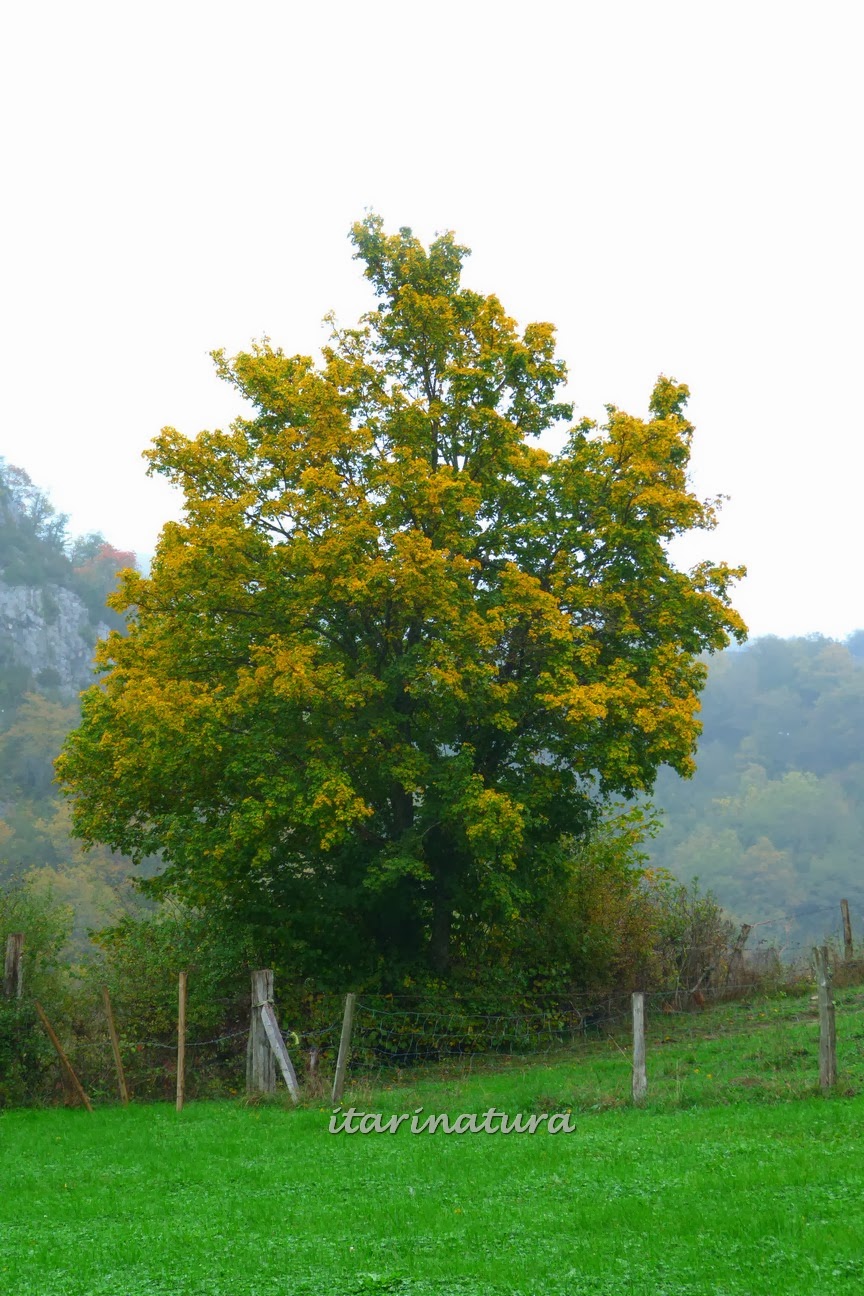
Lower Maple (Acer campestre)
araneus sp.

If you love photography of autumn, these are good days for this, and although light rain that is falling these days difficult the work, it also gives a special touch that a sunny day can not give.

Tuesday, November 5, 2013

The fall in Irati forest

Arrazola (Irati) Valle de Aezkoa 11-10-2013

It seemed a month ago that the fall would be advanced, as in many places due to the lack of water the leaves of many trees were changing color.
Now, however, the forest is so green that it seems that we fall, if not for the high areas catching color before the low, and the abundance of fruits, both hawthorn (Crataegus monogyna) and the of themselves have, among others.
Possibly, but will have to go see him week after week, the increased intensity and amount will be achieved towards the last week of October / first of November. 


Beechnuts (edibles)
This year is a for the beeches a "vecero" year, that is, one year bear much fruit, others much less. The" vecería" is more pronounced  as  the species more wild  are.
Here we are the fruit of the seed open and ready to fall. Squirrels, dormices, wild boards and many kinds of birds will eat  them. Common finches are of those birds that we see frequently eating beechnuts on the road where they have fallen seeds, which were then crushed by cars, providing work.
They are edible for humans, once easily peel and remove the hairs that can give us a little itchy in the throat.
In the pastthey was used for human  meal making flour with them, and later for the pigs.


Common finch( Fringilla coelebs)

Arrazola(Aezkoa valley,Navarre) october 20, 2013
There has been some change in recent days and the forest is picking color, although there is still at least a week to take all those shades of color that characterize the beech forest.
Arrazola Information Point ( Aezkoa Valley )
The temperature has undergone rapid changes , and we've had days of small icy morning. However, what is prevailing  is the warm south wind , and so today at 9 in the morning we were at 15 degrees celsius .
In principle , the prognosis for the fall holds for the last week of October, first of November.
T

Hypholomas in the water reservoir area of  Irabia. They are toxic

We have hit boletus, but yes a big variety of species, so a visit to the forest at this time we can offer good opportunities for photography.


The birth of an amanita.
Cortinarius sp.
Pale tussock(Calliteara pudibunda)

This beautiful caterpillar, abundant at this time in the beech forests around the north of Navarre, will become a beautiful moth or heterocero, (Limantriidae family) will fly for the months of April to June. Its caterpillar feeds on the leaves of the beeches, oaks, willows and hawthorns, among others.Despite its fierce appearance, is harmless.

5 november 2103

Arrazola car parks (2). At this time, the 3 car parks of Irabia reservoir water were full 

Already passed the long weekend of all saints (Halloween) where more than 2300 people passed through the entrance to Irati forest of Arrazola (Aezkoa valley) seeking  the colors of the autum. However, this year the fall is a bit late, and probably in this weekend will be when maximum color that can reach before the wind and rain (yesterday was raining all the day, and today remains the same) pull the leaves.

Irati, from the window of my house at 9:21

In the bordering southern valleys , however, it is possible to lengthen a little more, because having lower altitude the cold and wind they affected less , and because around here  oaks holds longer the leaf than beeches  (also emerge later.)