Monday, February 27, 2012

Stinking hellebore

Our second flower of this year show belongs to this small plant poisonous  and unpleasant smell (notice how attracts insects for make the pollination) and flowers quite discreet.
Like all plants, could be medicinal depending  the dose, but in this case is not recommended like home remedy via internal to be very toxic.

in case of poisoning could take an infusion of mallow (Malva sylvestris) and marshmallow (Althaea officinalis).


stinking hellebore(Helleborus foetidus)


stinking hellebore´s flower


Green hellebore (Helleborus viridis)

It has another close relative, the green hellebore (Helleborus viridis) over the fetid Atlantic climate is more Mediterranean. In Irati we can find both but predominantly viridis, because the Aezkoa valley is a place of climatology transicion between atlantic and mediterranean areas.area Now sprouts in places where the snow melts.

Sunday, February 5, 2012

The hard winter

February is usually a very cold month in Irati, and the snow covering the entire forest, and this brings difficulties for non-hibernating animals who need find  food.
The snow always makes easier the observation, because the contrast with the snow is higher, and  they can be seen at certain points when they go to feed.


Jay( Garrulus glandarius)

Here's a Jay (Garrulus glandarius) in an area for livestock barns, looking for food in the snow .The jay is a bird related to the crows, quite common in all these valleys, often very visible from the road, shy and very noisy. Always associated with forests of a certain size, is one of the best settlers of oak, to contribute very effectively to dispersion of its acorns, which they eat some of them.


In this photo we  can see a female Blackbird (the local name is Tordo or zozoa, in basque), taking shelter from the snow under a female holly (Ilex aquifolium). As is evergreen, offers a warm coat, and the little berries for eating , very poisonous to humans.
Females differ from males because they  feathers are browner and  the beak  is less  yellow-orange than males, too much black.


Female


common blackbird (Turdus merula)


 Tit (Parus caeruleus)

In this one, we have a Tit (Parus caeruleus), thoroughly inspecting all holly leaves, looking for remains of cochineal, a parasite of the leaves he had during the spring and summer.


Finally, we have this fox (Vulpes vulpes) photographed from the road to Orbaizeta , and was eating grass in a meadow, as dogs sometimes do, and possibly seeing if I was lucky enough to feed something more substantial.

 
Red Fox(Vulpes vulpes)


Sunday, January 15, 2012

Galanthus nivalis in flowering(14-1-2011)

Here we have  the first flower observed in this year.Is a kind of Lily, a relic of the Ice Age, and is classified as very rare. It is not very large, between 10-30 cm. and we can find in the north of Navarre  in very few places.

Sunday, November 6, 2011

Landagoien waterfall

At the entrance to Irati by Orbaizeta, just before going under the water piped  from the Marsh of Irabia to Betolegi hydropower plant, we have a nice jump of about 10 meters which Legartza race, the same as moving the machinery of Orbaizeta old arms factory, made ​​before lead into the river Irati.

It is quite unknown to the general public, it does not appear in any magazines or signposted path leading to it, though access is too easy.


 Landagoien waterfall(6th of november  2011)

  Today, due to heavy rains, offers a stunning picture, but has not been possible to take a picture from the bridge down, the best place for it, due to the large amount of water that splashed all inside.For this reason, I put a picture above, with less water.

Saturday, October 8, 2011

Irati news(2011)


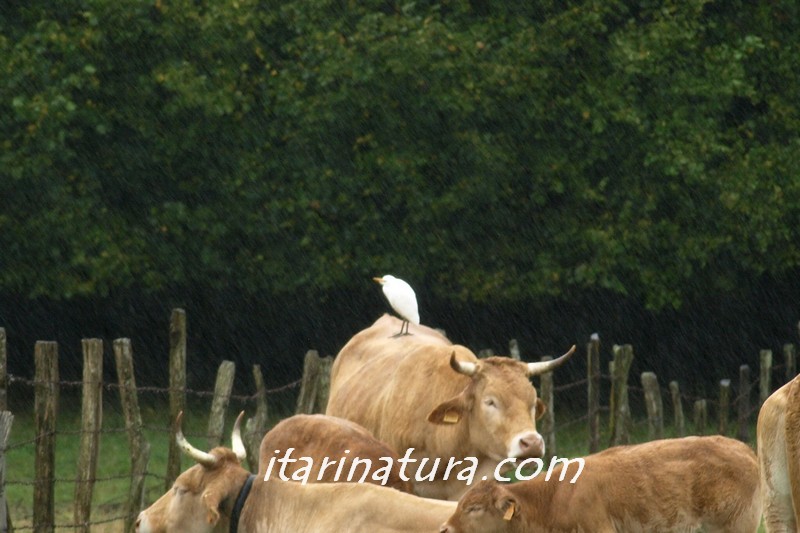
Here is a cattle egret (Bubulcus ibis) in migration to Africa fell yesterday as they won over the habit of doing.


(16/10/2011)

Yesterday we were lucky to see a bearded vulture (Gypaetus barbatus), about 2 years old fliying around the entry to the forest of Irati to the Valley of Aezkoa(Navarre), from the information point of Arrazola.

Today the show we had been with the thousands of cranes (Grus grus)that  have flown the same place from 13: 10 to the rest of the Day. In 3 hours we counted about 1950 cranes.

Tourists who were comming  there have had the opportunity to use astronomic binoculars to see them that we have for tourist and us, as well as several hands binoculars.


Arrazola (Irati-Aezkoa) October 20, 2011.

Here we have an abundant mushroom roadside, edible but almost nobody takes it, and we're going to do a little experiment.

This picture I took yesterday at 14:00 p.m. .How much will grow in 24 hours? And 48 hours?

Today at the same time I will take a picture and measure, and will continue so until the mushroom dies or somebody pick it up.


(22/10/2011)
Two days later, our mushroom was complety destroyed, probalbly for a cow or a mare,quite common around this area.End of the experiment!
We will try in a next one.


(12/11/2011)
50 Starlings in the entry to irati forest by Orbaizeta.


Today, at 15:00 p.m. we have seen around 50 Starlings ,perched among the cows, in the distric of Larraun (Orbaizeta).
Stirlings usually lives from the north of the pyrenees, and come to Iberian peninsula in winter during the migration.The next photo is of some of today´s birds.


Starling(Sturnus vulgaris).
common cranes (grus grus)killed by golden eagles(Aquila chrysaetos)(15/11/2011)


On Sunday October 13, a  environment warden, told us  that in the way of the holes of Anbulolatz (SL50-C),in about 10 minutes of information point of Arrazola, were the remains of a common crane (Grus grus),  which there were only some feathers and possibly had been struck down by a pair of Golden eagles that they live in Irati.

Based feathers were bitten, which are not made for birds of prey;they pluck the feathers of their victims,no bite them, indicating that once the crane landed, she was attacked by a carnivore, which  took her to eat later elsewhere. As is a large bird, I thing that could be attack for a  fox or badger, both very common.


In this photo, in February of this year 2011, we can see a dead crane in Azpegi (Irati) whose attack was observed, and we know they were golden eagles (Aquila chrysaetos) who attacked her.
The photo is  of Alfonso Senosiain.

something about crabs..

The Navarre native crayfish almost completely disappearances many years ago illegally introduced American species, perhaps thinking that introduced that would increase the chances of capture.

   As is almost always that man introduces a new species in an ecosystem, this was a terrible mistake, it was afanomicosis carrier, a fungus that are immune to two types of American crayfish (crayfish and signal crayfish), but deadly to the native.

Survives today only in racing headers to which Americans have not arrived.

While the American is, the native can not return to their old places, because the disease survives in American guests.

In this photo taken from the reservoir lake of Irabia, we can see the signal crayfish, present in almost all rivers in Navarre, and identifiable by the white markings of the tweezers.

The crabs play an important role in cleaning rivers, work now performed by American crabs to have kill  the locals.
it is important that Irati racing crabs remain free, because otherwise they could end up eating the eggs and kill anfibiosn protected species such as the Pyrenean frog or russet frog.


Friday, October 7, 2011

Reptiles in the forest of Irati

Arrazola (Irati from Aezkoa) October 6, 2011

Even when the heating season is running, you can still see some reptile heat up the road, when the black asphalt, on sunny days gets very hot, and as the reptiles are warm-blooded no need to get that heat outside.

The picture shows an asp (Vipera aspis) hit the road to Irati, who brought a friend so we could see it.


Tourists who spent yesterday were surprised to have the opportunity of seeing a snake so closely.