In early November walking near the nature reserve of Mendilatz in the Irati forest(Aezkoa Valley, Navarre) I found this substance in the meadows surrounding the reserve. Overall I found two of them.
They had no smell, had some consistency, and were slightly sticky to the touch. They weren´t bonded to the ground by any appendage.
I sent the photo to various experts in nature of the area, but although there were different theories, none of them seemed to fit with what could be.
Some of them talk about an artificial substance, but in that place did not seem very plausible. Also did not have any odor that could remind some chemical.
Other said it could be some kind of excrement, having ingested some gelatinous substance, like frog eggs (not yet exist) or even mistletoe fruits, but it was too dense to be something of that nature.
Another assumption was that of a kind of gelatinous fungus uncommon. It is true that there are very similar to the photography, (Myxarium nucleatum or Exidia thuretiana)
You can see something similar in these links:
www.fungipedia.es/.../32325-myxarium-nucleatum
www.asociacionvallisoletanademicologia.com/
The following link is interesting, because once one like it was related to the fall of a meteorite!
www.aforteanosla.com.ar/afla/.../amherst.htm
But do not think that is exactly none of these species, although probably will be a fungus. Nor growing on dead matter of some branch or organic waste.
If someone could give me your opinion would be very grateful, in order to be able to know more about the surprising nature that surrounds us.
You can leave a comment on the blog or write to:
Itarinatura@itarinatura.com
1 december 2012
Few days ago, Javier, from the Ultzama mycologic park, told me maybe could be a fungus of tremellaceae family , but he coudn´t be sure with a photo.
Information about the nature of the Aezkoan Irati forest (Navarre)by the team of guards. We offer: -information about the state of forest throughout the year, week to week. -ornithological information about birds observed by the team of guards. -Flora characteristic of every month. - Fauna observed either directly or through their signals.
Sunday, November 25, 2012
Sunday, November 11, 2012
Irati last colors and .. not buy helium balloons!
It is difficult to determine which is the time when the forest is more beautiful, but we can certainly say that now is precious. This year's leaf fall has been delayed more than last year (you can look at the blog at this time one year ago), but from here on out, sooner or later, the leaves will fall.In fact, they have already start to do, and there are very big thicknesses in many places.

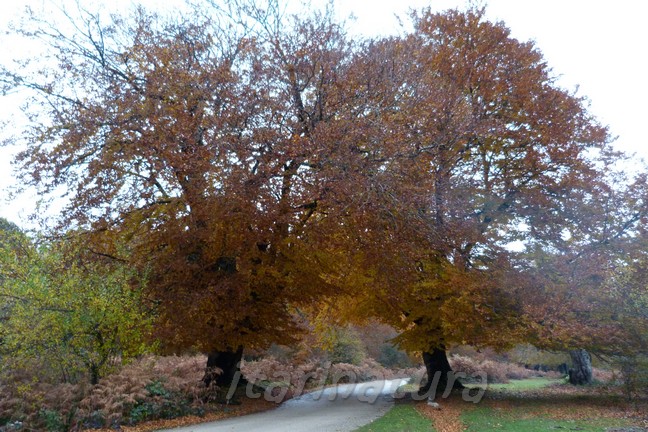
In this picture we can see the middle zone of the forest of Irati.Greens are losing every day, and give way to the yellow first, and then red and gold, which are most prevalent now.Why there is this color change?
Green indicate the presence of chlorophyll , where the plant is fed with normal light conditions.When it is decreasing, the green chlorophyll is replaced by the yellow xanthophylls, which are activated with a shorter wavelength, and that can continue making photosynthesis more time, before being replaced by the carotenes, which are what give red in nature.When the amount of light continues to decline, even carotenes serve them to make photosynthesis, and finally they fall.If you want to know more Try these links:
www.botgard.ucla.edu/.../xanthophyll...
http://en.wikipedia.org/wiki/Xanthophyll
There are other factors such as protection against the cold, so in warmer areas are larger leaves to evaporate more water while in the colder, the leaves surface are reduced like simple needles, as in the Siberian taiga.
We can find them in the lake of Pitillas(Navarre), in the gorges of the pyrenees, and anywhere else you can think like precious.5 years ago appeared in the branches of a beech of Irati a Mexican probe balloon with a small capsule of polystyrene where there was a small gadget with an explanation for who met him, saying it was not dangerous. He crossed the ocean through the jet stream in the stratosphere to Irati!

In this picture we can see the middle zone of the forest of Irati.Greens are losing every day, and give way to the yellow first, and then red and gold, which are most prevalent now.Why there is this color change?
Green indicate the presence of chlorophyll , where the plant is fed with normal light conditions.When it is decreasing, the green chlorophyll is replaced by the yellow xanthophylls, which are activated with a shorter wavelength, and that can continue making photosynthesis more time, before being replaced by the carotenes, which are what give red in nature.When the amount of light continues to decline, even carotenes serve them to make photosynthesis, and finally they fall.If you want to know more Try these links:
www.botgard.ucla.edu/.../xanthophyll...
http://en.wikipedia.org/wiki/Xanthophyll
![]() |
| Arrazola( Irati forest,Aezkoa)10 october2012 |
There are other factors such as protection against the cold, so in warmer areas are larger leaves to evaporate more water while in the colder, the leaves surface are reduced like simple needles, as in the Siberian taiga.
Now I will tell you the reason for my request about the balloons with helium.
This balloon hanging from a branch, in the middle of Mendilatz Nature Reserve, in the valley of Aezkoa, tells of a child who lost his balloon into the past holiday from somewhere distant. Air currents drag them tens, hundreds, or even thousands of miles to settle in places where the happiness of the party becomes human waste that causes problems.
![]() |
| We can see the silver ballon hanging from a branch. |
Monday, October 22, 2012
They are comming fall colors !
![]() |
| Irati from Ibiaga (Aezkoa) |
These images are from a trip that I made with a couple of Jaén( Spain) this morning:
As one example, enough it to say that when the elder begins to bloom in Pamplona / Iruña, located on the 60 km from the forest of Irati in Aezkoa valley ,start 15 days later.
Another thing to consider is that each species of tree lost its leaves at a certain time, and the sooner losing the leaves, earlier in the spring they will bring. Also in the forest we can distinguished by their color or details, and for the leaves giving the cup red burgundy of the opalus, or intense yellow of the maple rounded ,and the ash, more like a flame, ..
![]() |
| Ash in the way to the Irabia reservoir water (Aezkoa valley) |
Thursday, October 18, 2012
Forest of Irati in the middle of october
In two days, we will have some holydays to enjoy nature, and many people will approach to Irati forest searching those fall colors that we love.
It should be said that this holydays of october and November are bad dates if you want to enjoy the forest due to the big afluence of people.I Advise tocome at any other time of year or if this is not ,go to the other areas of Irati differents to the reservoir water of Irabia. In any case, you will always wellcome, and as we can not always choose the days of the holiday, here you are an example of how the forest is today..
![]() |
| Irati from Arrazola(Aezkoa) |
![]() |
| Irabia reservoir water´s way from Arrazola |
![]() |
| Field mapple (Acer campestre)beginnig the color change |
![]() |
| Mozolo txiki mountain, from the top of Ibiaga |
![]() |
| Arrazola( Irati) 10 october 2012 |
As you have appreciated in the images, the forest is preparing for the winter, but not in a hurry. It is possible that this week has been great changes due to possible rain and falling temperatures.
Walking through the woods in the raining, can be a beautiful experience, as long as we stay dry. If you coming, do not forget the umbrella and good shoes!
Thursday, October 4, 2012
The colours of the forest in october first days
There are many people who are waiting that the forest get those beautiful fall colors for a visit to Irati or other deciduous forests, but due to the recent rains and the absence of fine cold winds or heavy rains, the landscape of Irati has not changed very much. Only some branches in the forest have decided ahead of the rest.
In the photo above we see the start panel a bush with red berries. It´s a hawthorn (Crataegus monogyna) with edible fruits among the leaves.
The netx photo comes from 20 October 2011. You can see the fall was more advanced, but there was not a big difference.
If there is a sudden drop in temperatures during a week, then the color will come in shortly.Otherwise, probablywe will have to wait several more weeks, and meanwhile, enjoy the spectacle of the rut deer (Cervus elaphus) that these days we can hear them at night or evening mainly, even from the villages.
![]() |
| Path of the pollard trees.Arrazola(Irati) |
In the photo above we see the start panel a bush with red berries. It´s a hawthorn (Crataegus monogyna) with edible fruits among the leaves.
![]() |
Fruits of hawthorn and a baby thrush |
The netx photo comes from 20 October 2011. You can see the fall was more advanced, but there was not a big difference.
If there is a sudden drop in temperatures during a week, then the color will come in shortly.Otherwise, probablywe will have to wait several more weeks, and meanwhile, enjoy the spectacle of the rut deer (Cervus elaphus) that these days we can hear them at night or evening mainly, even from the villages.
![]() |
| Arrazola(Irati)20/10/2011 |
Thursday, September 27, 2012
A hot nest
A few days ago, clearing the access to the swamp of Irabia of little landslides (marls), they appeared by chance a lot of small and fragile shell eggs.
I counted 20 eggs in total, between hatched (the majority) and those who followed integers.They had very soft shell.
.When broken one (it was inevitable, using shovel and hoe but carefully) certainly could see what they were.
Definitely they were common wall lizards (Podarcis muralis) rockers, whose eggs were still warm in the loam, south side, ease to heating.In the picture above we can see still the breeding with part of the yolk that served as food.

Once out of the shell, and letting the sun was getting some vitality.
Lizards are great insect eaters, and unfortunately fun for many school boys and girls in the yards of their schools or walls of the villages .
![]() |
| Before the cleaning |
A few days ago, clearing the access to the swamp of Irabia of little landslides (marls), they appeared by chance a lot of small and fragile shell eggs.
![]() |
| During the cleaning |
I counted 20 eggs in total, between hatched (the majority) and those who followed integers.They had very soft shell.
.When broken one (it was inevitable, using shovel and hoe but carefully) certainly could see what they were.
Definitely they were common wall lizards (Podarcis muralis) rockers, whose eggs were still warm in the loam, south side, ease to heating.In the picture above we can see still the breeding with part of the yolk that served as food.

Once out of the shell, and letting the sun was getting some vitality.
Lizards are great insect eaters, and unfortunately fun for many school boys and girls in the yards of their schools or walls of the villages .
Wednesday, September 12, 2012
Commmon Buzzar (Buteo buteo)dead in a fence
In this photo we can see the remains of a Common Buzzard (Buteo buteo) that apparently got caught in a fence-ups, made for the purpose of separating the pasture area of the forest, in order to promote better forest regeneration and have controlled livestock (sheep, cattle and horses).
| Remains of common buzard (Buteo buteo) |
The coin next to the skull gives us an idea of the scale.
This raptor is abundant in all northern valleys, and is often seen in flight or inn above telephone poles or trees like in this photo,looking for mices and other small prey.
![]() |
| Common buzard(Buteo buteo) in Irati |
![]() |
| Silhouette in flight. To identify: white collar under the neck. |
Subscribe to:
Posts (Atom)