Monday, March 16, 2015

Birds, flowers and wildcats in march.

After being snowing heavily during all February and have an historic snowfall, the rain came. The snow began to melt causing floods that were affecting localities of the midle and south of Navarre..
In this bend the Irati River flooded the road and was cut overnight.


Irati  riveer between Orbara and Aribe ( Aezkoa valley)
when the snow melted, the grass was been visible, and  herbivores went quickly to eat grass that was hidden.
When snow began melting
Deer grazing. Picture taken from the window of my house.

But the field mice ( Apodemus sylvaticus) and moles (Talpa europea) also took advantage of these days of tranquility to leave their burrows. The Wildcats (Felis silvestris) stand guard at the entrance of molehills or mouse burrows, waiting to attack minimal movement.
Sometimes, in the same meadow, I saw a fox, 4 deer and one wildcat.
On another occasion, I saw up to three Wildcats in the same field, and a fourth in the other side of  the Irati river.

Wildcat  (Felis silvestris)
Often  they are near from the villages, so, how can we recognize if there is a Wildcat  or common cat, at first glance, and from far away ?

  • Color: all  of them have earth color, to blend with the environment. Sometimes  they hybridize with domestic cats, and can be really difficult, if not impossible, know if they are  hybrids or not, from far away. If unfortunately we find one dead, there are typical design of dark stripes patterns on its back.
  • Tail: Much thicker than a domestic cat, has several broad dark rings, and the end with a black mark.
  • Size: There are more corpulent.
  • Behavior:  Always they are exceptions, but if it is a domestic cat let us come closer. If the wildcat is observed, and is relatively far, will tends to flee, and if we are too close, about 25 meters, often he sticks against  ground watching us, and if we have not seen him moving before, we can think it is a mound of a molehill, or cow dung.
This saw me

With snow are more visible.

Crouched, fixing his gaze in Me


But also March also brought a spectacular migration.
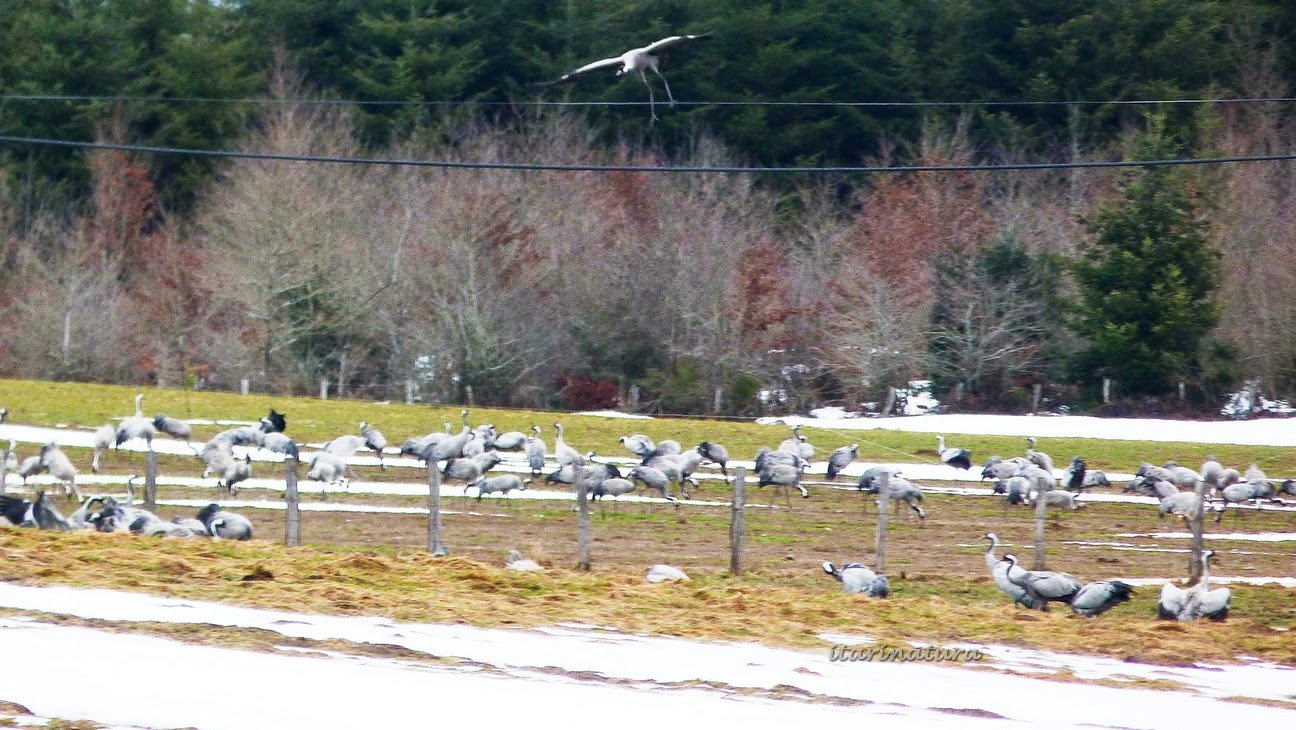
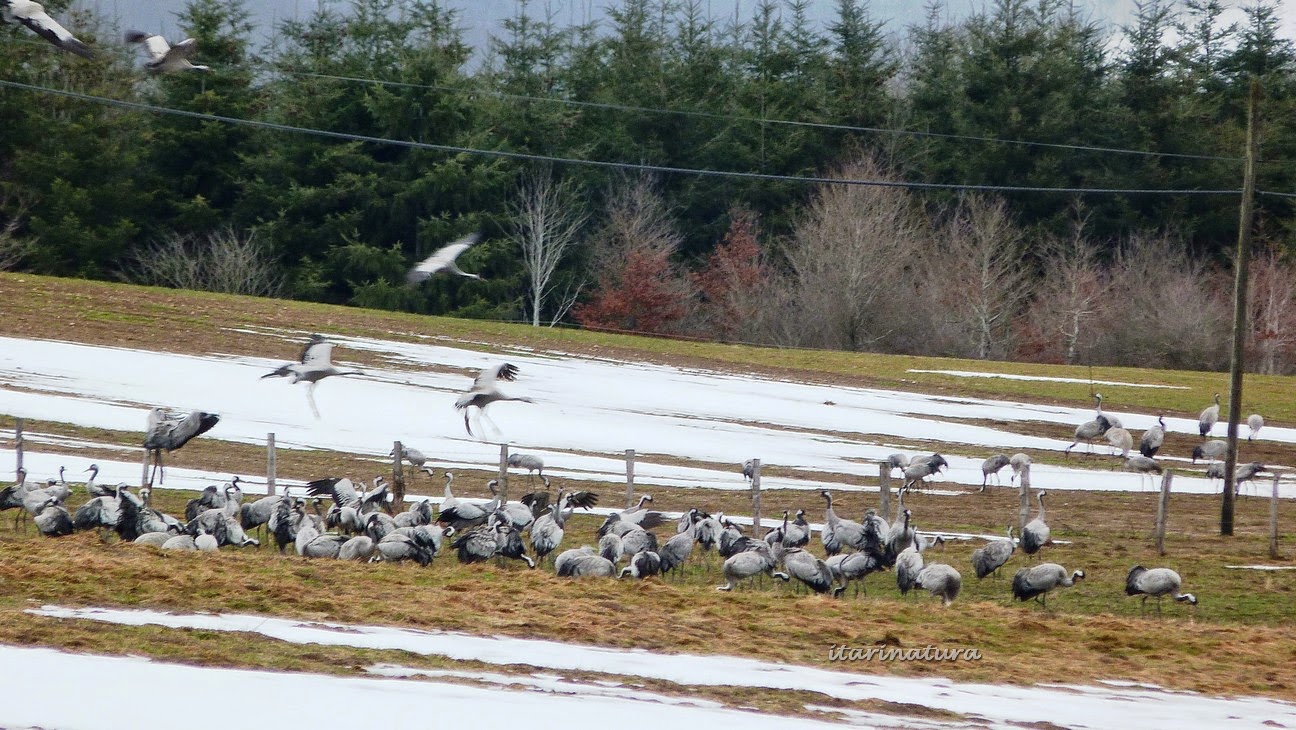
At first  the cranes came in a very good day, but the weather worsened again. Then,the white storks came, and some black storks too.

white storks in Ekai, near from Agoitz/Aoiz (Navarre)

White storks (Ciconia ciconia) on the way to the rest of Europa.
Somewhat later, on March 5, they also appeared in Orbaizeta, dozens of them.
 Older people commented place only once saw something in this village.


It happened that there were some badweather days, after having been rising temperatures and the birds that were already on the way, they met the Pyrenees covered with clouds, and decided to wait.
In the  Santiago´s way, at the crossroads of Auritz / Burguete the road to Garralda, We could see thousands and thousands of cranes circling above the meadows as deciding what they would do.

Ortzanzurieta mountain,in the end, and Auritz in the end left


Eurasian stone- curlew (Burhinus oedicnemus)

Black stork( Ciconia nigra)
Days later appeared lapwings, little Egrets and some flocks of small birds that I could not identify.
little Egret (Egretta garcetta ) and lapwings in the bottom

Lapwing (Vanellus vanellus)


The flowers that you can see below, are usually the first year to bloom by mid-January, but this year have been delayed until the first week of March!
As I have said on other occasions, The snowdrop (Galanthus nivalis) is a rare survivor of the flora that we had here in the last Ice Age. When the ice move away to the north, most of the plants and animals typical of this climate were disappearing, but some of them resist, always close to the border of extinction.

Snowdrop (Galanthus nivalis)


Finally, a photo of the full moon of March. The winter sky is spectacular to see some constellations of this time as Leo or Orion, and have a clean atmosphere. Of course, dressed with warm clothings.


Fullmoon in Nagore (  5 mars 2015)


Monday, January 26, 2015

A winter day, somewhere in Navarra


This time I will not say where I've been, because I am going to show you 2 species in danger of extinction, but I think that will be many people with the tracks that I going to give you, who will recognize the place.
If someone  want to visit it, I'll be happy to do so.

Nummulites
Lets begin with the composition of the rocks of the place; as you will see, they are full of fossils of some 55 million years ago and  marine origin. They are called Nummulites, and is a composite Latin word (nummus / coins, litos / stone). If one sees flat, they look like coins with concentric circles, but if it turns out that the bug (not an animal but a unicellular be called protist) was on side when fossilized, or broke, then they are more elliptical.
They are foraminifera,   http://en.wikipedia.org/wiki/Foraminifera a kind of macroplacton, swimming in the waters of the prehistoric sea that disappeared when the Iberian peninsula was built against the European continent.
Among its concentric circles, sprouted a number of something similar to a little hairs with which they fed.
The main of the limestone of  the  Pamplona/Iruña basin, looking to the south, are made with skeletons of trillions of these beings (Alaitz and Sarbil ranges, pilatos balcony, above Urederra fountainhead, ..)
I have found this very good link about these things:(in spanish)

http://www.geoparquepirineos.com/contenidos.php?niv=&cla=_2OA1CD0KM&cla2=_2OB01HU8N&cla3=_3MD0KXM4T&tip=3&idi=1

The second clue corresponds to the river that flow in this area. Its waters have been carving in the rock several circular holes called potholes. Sometimes,  a stone  is trapped by the current in an imperfection of the rock, as a small hole, and with the water movement this stone begin Smoothing and getting bigger the hole until it can reach several meters in diameter.

http://es.wikipedia.org/wiki/Marmita_de_gigante

Pothole with the dead trout
In this small pothole beside the river which coming rise due to the snowfall of yesterday, a poor troutfound the death. I do not know if the rise would have pushed into the pothole which later it could not get away, or died of old age after a full life, but the truth is that was recently died there. Gills were still red, but the skin was beginning to fade.
I put my hand to hand as size reference.


A few meters we can see a small seam between two limestones  of crystallized calcite. When these rocks were forming, hot water and great pressure fill of lime circulated through a crack, until calcite began to accumulate on the walls of the crack, filling them and sealing like cholesterol in our arteries. This procedure is the same when we found a vein of copper, silver, gold and many other minerals, but in that case, would be other kinds of rocks which would have to look not in sedimentary rocks, but in metamorphic, and almost always attached to quartz.


Calcite crystals 


Latest clues!
It is the Bearded Vulture foraging territory, abundant colonies of griffon vulture, and now in winter, a rare bird jewel, the walcreeper (Tychodroma muralis)!


Bearded vulture (Gypaetus barbatus)
Griffon vultures (Gyps fulvus)

Wallcreeper (Tychodroma muralis)

This beautiful Wallcreeper was takin benefit of the sun's rays to eat the few bugs that appear in the heat rock or  refuge in the numerous cracks and holes.

So, although it seems that few things to see in winter, actually in all seasons there are many things to see


Thursday, December 4, 2014

Dinosaur Footprints from the "Plaza del castillo" of Pamplona ... in Madrid?

Carmen U. Godzillin paleontology blog, sent me a link to his article published in April 2009 entitled "huellas con historia",(footprints with history), which sheds light about the plate that at present is showing in Madrid:


 http://godzillin.blogspot.com.es/2009/04/unas-huellas-con-historia.html

According to local news from the National Museum of environmental science:

http://digital.csic.es/bitstream/10261/79993/1/NievesAldrey2009_periodicoMuseo.pdf

Was in 1876 when  Alfonso de Aretillo y Larrinaga found in the old floor of "plaza del castillo" the plate with the dinosaur footprints,and chose among others, to be  investigated in Madrid. The cityhall of Pamplona in that time finally gave the piece for the museum of Madrid.
So, although the events of "plaza del castillo" were as I told you in the previous article, this piece is not for those events.

Before publishing the news, I had looking in google search engine introducing the words dinosaur, arqueosaurio, Plaza del castillo, Pamplona, .. but  nothing found. As on the short museum  information card dont appeared more details than you saw, and taking into account the history of concealment of the excavations of  "plaza del castillo" from Pamplona, it seemed clear the conclusion ..but no. I was wrong and I apologize because all information that I previously published is contrasted and this is the reason that I usually put all the links that I can about it. If this new had it been what seemed , nor I could have found references online.


Now, the question would be: what happened with the rest of plates with dinosaur traces that speaking in the article, and where they came from.?  Because in Pamplona, there is no middle Triassic. By the time of formation of these plaques, and that in the nineteenth century would not carried  stones for paving a square outside the province.
It seems that the oldest rocks in the area of Pamplona is precisely from this time, located in the valley of Ollo and cendea  of Iza. However, they are not  mostly limestone, but gypsum and ophites, as you can see here in Euskomedia:
http://www.euskomedia.org/PDFAnlt/prehistoria/04/04061096.pdf


La historia de los materiales geológicos que aparecen en las Cuencas, puede remontarse
hasta el Triásico Medio, cuando el territorio queda cubierto por un lago salino, en cuyo
fondo empiezan a depositarse arcillas con algún nivel de caliza, yesos y sales (Keuper). Al final
del Triásico y durante el Jurásico, este lago del Keuper se abre al mar, que tendrá pocas
repercusiones para lo que luego serán las Cuencas Prepirenaicas. Durante este largo periodo
que llega hasta el Cretácico Superior, se van depositando en un fondo marino las calizas
y margas que hoy rodean las Cuencas.

The history of geological materials appearing in  the Basins, can be came from
the Middle Triassic, when the territory is covered by a saline lake, in which
background begin depositing clays  with some level of limestone, gypsum and salts (Keuper). 
At the end  of Triassic period and  during the Jurassic, this lake of Keuper opens to the sea, which will have little implications for what will be the Prepirenaicas Basins. During this long period
that reaches until the Upper Cretaceous, are deposited on a dark background limestones

and marls that  today surrounding  the basins.

So if you encourage  to lookin for the quarry from came this  stones, I would start in this area, but if you find something of interest, Warn  to the forest rangers of Navarre!


Sunday, November 30, 2014

Dinosaur traces from Pamplona....in Madrid?

Image of traces of arqueosaurio from Pamplona/Iruña, in the museum of Madrid


Yes, I was astonished, like the stone slab of the image.
I was in a workshop of tourism in Madrid, and, to take advantage of my free time, I went to the museum of natural sciences. Very interesting all exposures.
In the area dedicated to paleontology, I found this slab looks like limestone, with ictites, or fossil footprints of  animals. I could not believe when I saw where he came from. According to the board, comes from the castle square(Plaza del castillo) of Pamplona / Iruña.
Anyone who knows the plaza del castillo(Gaztelu enparantza in basque) will know that this is one of the oldest sites of Pamplona, where for thousands of years there has always been some kind of construction, so something like dinosaur traces, and from middle Triassic (about 230 million years) is not on the surface. So, how did they find?

http://en.wikipedia.org/wiki/Chirotherium

From 2001 to 2003 the Plaza del castillo was destroyed to make an underground parking. During the works that could see heavy machinery in an area of very high archaeological value, it came to the light the largest Muslim cemetery of the north of the Iberian peninsula, a convent of the tenth century, the remains of two castles, the Louis Hutin`s one , and later one of the invader Fernando Catholic (which it did with previous stones to preventing that the Navarre king will return to retrieve Pamplona), a large piece of a huge Roman wall of the  high empire with the base of the towers, (and now we can see into the parking cuted like cheese for the cars), Roman baths, and an unknown menhir, funds of prehistoric huts, etc ..
Most of these things ended up as rubble under the new houses Lezkairu.
Due to political affairs, stubbornness and absolute contempt for the history of our people, was destroyed what could have been an open-air museum revenue generator for the city, and a golden opportunity to know thousands, now with dinosaur footprints, million years of history of the city.

But was unknown  that after razing the human historical part, They kept digging and found this, they took him to Madrid, and exhibited there. Who was the paleontologist that researched it ? Where is the rest of the plate?
The archeology team that was sent to disassemble the Roman baths, asked how he had to dismount Roman baths, because nowhere in the world is dismounted, but are conserved. As they could not make it morally, resigned, and hired other people able to look away.
I put some very interesting link, especially the first three, because they are more precise, for you would want to deepen you may do so.
I beg you to spread  this, to let people know what politicals did and not happening again, and if possible, all remaints are brought to light, and returned to their place of origin.


http://www.nabarralde.com/es/gogoeta/1575-un-museo-en-la-plaza-del-castillo
http://www.pampiruna.com/obras%20plaza%20castillo.htm

http://www.amaata.com/2013/04/los-150-grafitos-excepcionales-de-la_4.html
http://es.wikipedia.org/wiki/Plaza_del_Castillo


Wednesday, October 1, 2014

Autum is coming! Colours mushrooms and gastronomy. Last photos

12 september 2014 Aribe ( Aezkoa valley)
 The arrival of autumn is anticipated by migratory birds, many of which have already taken their way  to the south to warmer climates with more food than there is for them in this land for the next months. It is  for common house Martins (Delichon urbicum) that meet every year at a certain point, in every town, and decide to start the long trip to sub-Saharan Africa.


And by the way I will comment that this painted wall corresponds to Trigolimpio, an association of  local farmers dedicated to market their organic meat of pony, beef and lamb from our Pyrenean valleys who lives in fabulous condition which we can see if we go to the higlands of Irati, and the sale reverts entirely in them, without intermediaries, enabling the survival of the livestock on these lands. I encourage you to taste it.

http://carneecologicanavarra.com/index.php?id_category=7&controller=category&id_lang=1

As you can see in the following photo, the colors of Irati take to come yet, and as usual, about 1 month, which is not to say that the forest is not pretty.
The warm temperatures, lack of consistent rain, the subsequent lack of wind, and it's still early, makes the leaf fall does not arrive.

Irati near from  Orbaizeta old munition factory , 26  september 2014


Orbaizeta 12 october:

I  add you some photos to look the colour of the forest. They already have more color, but there are still lots of green. My forecast is still for the last week of October, first of November.


 Aezkoa valley, from Orbaizeta,  1km to Irati

View of the Ori  mountain (Salazar valley,) from Orbaizeta (Irati south west)

Beeches and Scotch brooms (Cytisus scoparia)

Hygroscopic earthstar( Astraeus higrométricus)


5  november

The rain and cold, and because we are in the middle of the autum, they are favoring the final color changement. On the summits from 1200 meters,we can begin seeing the snow, and the color of the forest has increased very much. In the valleys we have still up to 40% green.
If you come this weekend, you will find it quite nice, and probably will not last much longer.


Olaldea /Garralda Oak forest, few kilometres to the south of Irati
The mountains further south, riches in different  species of trees have started earlier with the change of the colour that we expected in the beech forest.


 Arpea Cave ( Garazi/ Cize Valley)
This year the highlands of Irati are not so dry as is usual in other years , and they has continuously been sprouting grass. we can see in the photo the  Arpea cave, that looking the green hues (I have not retouched the photo ) seems spring.


Mushrooms have been a shy presence due to the high temperatures and lack of moisture, butspecies like the  Amanitas  seems get very well.


Fly amanita (Amanita Muscaria)
A mushroom consumed in Navarra, but not for all people, is the Galanperna or parasol mushroom, which has sprout abundant in meadows and beech forests, but in drier places did not be in existence for long before  dry as cardboard.

You can see the size of this item, it´s big like a hat:

Parasol mushroom  (Macrolepiota procera)
 I told you...

As big as a hut..


With the rut this year we had something similar; although normal in other years was to start around 15 September, this year has been delayed a lot, and it was not until earlier this week, on Monday 20, Tuesday 21, which has not begun to hear and low intensity and duration.


But what most people are waiting for is the begining of mushroom season. 
The boletus edulis, or Porcini, onddo beltza called here, have not yet come out in significant number, but  many months we started harvesting other types of mushrooms, such as Sweet tooth  or Tripaki  (Hydnum repadnum), the horn of plenty (Cratarellus cornucopioides), or  the  Zizahori or Chanterelle,(cantharellus cibarius), among others.

Obviously, there are also toxics, mortals and indigestibles, and that makes (and they do well) that many people  they dont catch species  unknowns.
What is best in my opinion, is to go slowly, expanding knowledge and continue to consume only those which are safe, but now some of them more.

 Therefore, every Saturday afternoon in October, we offer guided tours to the mountains, where we will see many things as usual, but also we will pick,mushrooms, goods and not edible specimens, later to classify them according to some simple keys  of  GARRAPO,company, and then have dinner every Saturday at a different restaurant in the valley, prepared differently, and all for a fixed price of € 40 + VAT. 

They will be small groups of no more than 10 people, because is a lot of work to clean and cook the mushrooms almost the same time that we  give they.
 Places are still available for the 4 Saturdays, so I encourage you!


CALENDAR OF TOURS AND DINNERS IN AEZKOA (NAVARRE)

v  4 october PARDIX Restaurant  (Orbaizeta) 948 76 60 01

v  11 october  ARIBE Hotel Restaurant (Aribe) 948 76 44 66

v  18 october  HERRIKO OSTATUA Bar (Garralda) 618 10 73 79


v  25 october   SARIGARRI inn (Abaurrepea) 948 76 90 61


The company GARRAPO are friends and managers of the mycological Ultzama Park whose magnificent web I recommend you,  ,http://www.parquemicologico.com/

With them I did last year a training course to complete the knowledge I already had beforehand, because when I was  I went going with my family  in many times to take  mushrooms.


 Finally, I will commentyou something about the fascinating world of fungi;
The photo  that you have below is the Armillaria ostoyae, somewhat old. It is a fungus that can be  a pest because  rot the healthy wood ,It is edible, although here there are no custom of eating.
The amazing thing about this fungus, and probably many others, is that in Oregon (USA), there is a clonal colony of this fungus, and at the moment, is the largest known organism with more than 890 hectares and 2400 years old. 
Do not imagin a typical mushroom out ground.Is the mycelium, like the roots, going underground among the roots of trees.


Armillaria ostoyae in Irati

Lactarius piperatus


The strange mushroom ( Phragmobasidiomicetes?)

Charcoal burner or Gibelurdina (Russula Cyanoxantha)


Sunday, July 27, 2014

Cleaning in community work the Orbaizeta old munition factory

Cleaning the old workshop of examination of the ammunition 

In June during days 18 and 25, members of the tourism sector Valley Aezkoa who wanted do things despite the cuts and the lack of grants administration, met in the munition factory for Orbaizeta to improve accessibility and provide a more appropriate image as it is one of the main attractions of the Aezkoa valley.
With the approval of the council of Aezkoa Valley, owner of the ruins, we organized an auzolan or community work with the first goal of cutting the grass, cleaning trash, shut off the most dangerous areas and create on the slope some steps to the river Legartza, and people can admire the 21 stone arches that separate the coal from the rest of the factory.
But undoubtedly the most important goal of all was to start doing things like tourist sector of our valley,and begin to believe by working together, it is possible to do things if we unite wills.

Making steps down
To make the descent to the river was necessary  make a channel for a small but steady trickle of water that made the descent a something dangerous  for the constant mud that formed there, chiseling the steps with a hoe, and make a handrail which eliminate the danger of the side more height.

The posters were also being cleaned, by the time had gone dark with algae, which looks like this kind of material.

Cleanliness posters
Cut, collect, carry.
The amount of grass and brambles to grow over time did take us all day, and that we were about 8 people.
Taking the grass with the "sarde"
Cleaning the patio of carpentry workshops (right) and locksmith (left)


The "hamaiketako"

Around 11 am we stopped for brunch all, what is here called Hamaiketako, which in Basque means literally "the eleven´s one". The council of Aezkoa Valley paid the lunch, besides petrol to brushcutters,  and a accident insurance for the whole day
Garbage accumulated mainly in the Bokarte

In bokarte area, a large stone arch in the middle of the factory, we collected a lot  of garbage accumulated during many years  being used  the factory as a dump . The typical attitude of "if you do not see it, does not exist and is not my problem." We could find plastics in perfect condition as if they had thrown yesterday, and some much older things like shoe soles or bits of leather, certainly with many years but were decomposing smoothly.
The next day at work we find much more trash under a mixture of soil, leaves and stones.

The following week we decided to focus our efforts on cleaning the bokarte, where the collapse of a wall had covered much of the stone bath where was a wooden wheel that moved a  machine to crush the slag from the two  furnaces.

The bokarte, before cleaning without water
After the cleanup. Would you want a shower?
As this machinery was moving as all others by the force of water, the water is still falling to the bokarte from the Iturroil brook, channeled for it, and whose entrance I show you below.

A detour causes some of the water can get through a secondary channel and go to bokarte.
Channeling  Iturroil brook.

The  second day team


There is still much work to do, to be able to leave as many years was  after the labor camps developed almost 30 years ago. 
No doubt we will meet again to do all that we can without money , hoping that one day, we can get financing for real consolidation of the ruins, which are falling apart a little more each year. 

I want to thank everyone who worked, and somewhen they will work, their volunteer work, which shows that if not always, sometimes where there is a will, there is a way.